Showing posts with label Photography. Show all posts

Wednesday, February 20, 2013

The Hidden Coast

     California is known for its abundant natural beauty, bustling cities, and unique cultural blend. Some of the Golden State's more remote locations, however, offer a glimpse of a California that is often talked about, occasionally filmed, but rarely seen. Big Sur and the Central Coast give visitors a look at California's Hidden Coast.
"The Bixby Canyon Bridge"
     When speaking of the Central Coast, a common question refers to Big Sur: What is it? The best way to describe Big Sur is as a region, a stretch of the Pacific Coast Highway reaching from Morro Bay in the south to Carmel in the north. Although there is a township with the same name, its borders are not clearly defined, and it mostly consists of a few restaurants and a gas station. The Big Sur region is inaccessible from any route other than Highway 1, and this may be one of the most windy segments of the famed PCH. The drive is harrowing for those prone to motion sickness, but the reward is an astounding 70 miles or so of completely unspoiled coastline, full of breath-taking views of turquoise blue and emerald green waters waters crashing into the rocky cliffs.
China Cove
     When we reached the northern end of Big Sur, just a few miles south of Carmel, we decided to stop and walk around Point Lobos State Park. I can safely say that it's the most beautiful place I've ever been in California. The park is filled with coastal walking trails, and is also known for some of the best snorkeling and scuba diving in the state. If you're able to visit, be sure to stop by jade-green China Cove.
Hearst Castle's Roman Pool
      Hearst Castle is worthwhile strictly for the novelty of the visit. A testament to the dangerous combination of insanity and wealth, seeing the artifacts brought from every age and culture really is interesting. Some of the architectural features are truly striking; my personal favorite was Hearst's indoor swimming room, known as the Roman Pool.
Morro Rock
     Morro Bay is known to some as the "Gibraltar of the Pacific." A large monolith juts out of the bay, creating a natural barrier between the small town and the sea. A quaint little city, Morro Bay presents an eclectic mix of operating fisheries and commercial businesses, galleries featuring local art, and an assortment of tourist traps of every nature. It's a ton of fun. We spent the day by renting a boat and touring around the bay in the morning, and moseying around the piers in the afternoon. Since it's only about 20 miles north of San Luis Obispo, Morro Bay makes an excellent and relaxing day trip for those visiting the area.
"Devotion" Inside the Mission SLO
     San Luis Obispo is a great town. The downtown, which features a river-walk, centers around the Mission Plaza. On Thursday nights, a "farmers market" springs up on Higuera Street, although it contains more vendors of pre-made food and wares than actual fruits and vegetables. The Mission San Luis Obispo, which sits in the heart of the city, makes for an interesting morning or afternoon. The Missions always intrigue me, and I make a point to visit them. Symbols of the mixture of religious goals and political desire, the California Missions are definitely an interesting piece of history. Be sure to walk through the gardens, and capture some of the stunning views of the mountains to the east.
     Pismo Beach is absolutely insane. As the only public beach in California on which you can legally drive motor vehicles, it isn't what you may expect. An odd assortment of red-necks and hippies and plenty of something in-between, Pismo Beach is definitely interesting. Be warned, however: driving in the sand isn't simple. After we were towed out by the kindness of strangers for the 3rd time, we were informed that it is necessary to deflate your tires. The heavy traffic on the beach itself can make for much confusion and chaos. However, beyond a short fence on the beach, lie the dunes. Despite my expectations, these became one of the highlights of my trip down the central coast.
     The Pismo dunes are the exact opposite of what you expect to find at a California beach, which is probably why they were featured as the set of Francis Coppola's "The Ten Commandments." They certainly would look more at home in Egypt. As I was asking for some tips about the dunes from a local, he said "Be careful to not go in too far, it's easy to get lost in there." Something in my eye must have told him that I wasn't one to be concerned for that sort of thing. Grabbing an extra bottle of water, I promptly headed as deep into the dunes as I could. On my way to the center of the dunes, I met up with a few middle-school aged kids riding body boards and cardboard sheets down the dunes. As locals, they said that this was one of their favorite things to do on the weekends. After about 45 minutes of trying to find the ocean again, I realized that I was lost. Pulling out my cell phone, I saw the ever so ominous "No Service" bar. It was wonderful. An unexpected, actual adventure. No people in sight from the top of my solitary sand-hill, no sounds except the very distant whistle of the wind blowing shapes through the dunes. It struck me then that this is what California is about. It's about being alone on top of a sand dune, as much as it is about being packed like a sardine into a subway in San Francisco. It's about driving up the coast on a rainy day, and stopping to gaze at the ocean any way as much as it is about zooming through the busy streets of Los Angeles. After a few hours of wondering along, I heard again the distant roar of the ocean and the freeway again, and I noticed a few bars of signal appear on my phone. I was back from my 3 hour tour of solitude, back to bustling Pismo Beach. I guess that it's things like this that make me love California, the Golden State.
The Pismo Dunes
    
 PS: Be sure to check out my new Tumblr feed, right here: http://photographicwanderer.tumblr.com/

Thursday, January 3, 2013

A Lack of Color

Over winter break, I had the opportunity to go out and shoot some of my favorite local spots. I ended up shooting quite a bit of Black and White, and thought that it'd be appropriate to open the New Year with some of my favorite shots from the end of 2012 and the beginning of 2013.

"Hidden Chinatown" A women working in Chinatown's Golden Gate Fortune Cookie Factory

Oakland's Cathedral of Christ the Light
The interior of the Cathedral of Christ the Light

The Bay Bridge at night

St. Peter's and St. Paul's in North Beach

"Down Paradise Alley" A natural double exposure

Fire Escapes

Sunday, December 9, 2012

Photo Favorites 2012

Well, 2012 is almost come to a close. It's been a fantastic and eventful year for me, with travel through Mexico, China, as well as several parts of the US. I'm eager to see what's in store for me in this coming year, and if you get the chance, check out my fundraising campaign to send me to Cambodia this summer! In no particular order, here are my personal favorite photos from 2012:
"Changing China" The Canton Tower at night in Guangzhou.

"Old St. Paul's" The Cathedral of St. Paul, MN


"When the hurlyburly's done, when the battle's lost and won."-Macbeth

"That Starlit Beacon" the Pigeon Point Lighthouse at night


"Fading Act" a man in Guangzhou demonstrates the disappearing art of Cantonese Finger Painting
"Temple Park" A man paints with water outside the Temple of Heaven in Beijing

"Peking's Secret" A maintenance bicycle parked in Beijing's Temple of Heaven

"Will You Help Them?" A girl at an orphanage in Northern Mexico
My "Wall Project" Check back a few posts to read all about it!

Saturday, November 17, 2012

Pigeon Point Lighthouse

      On a lonely stretch of California's Highway 1 between Half Moon Bay and Santa Cruz sits the Pigeon Point Lighthouse and Hostel. The rustic structure nestles into the windswept shore. Ice plant drapes down the cliffs, forming natural curtains to the coastal bluffs. As a resident, I can say that California didn't get it's reputation for nothing; it truly is a beautiful state.
"Nothing is but what is not"-Macbeth
West Coast Sunset
      Pigeon Point, still a working lighthouse, was built in 1872. In the 1960s, the Keeper's Quarters were converted into a hostel, which is currently managed by the non-profit group Hostelling International. Although amenities are few and the location is remote, the hostel provides guests with an unrivaled experience. Nearly every window has dramatic ocean-views. A deck wraps around the lighthouse grounds, extending out beyond the point and providing guests and visitors alike an unrivaled view. Beds can be obtained for as little as $26US, and the lighthouse grounds are managed by the State Park system, so you can visit for just a day.
Old Coast
     It was nice to have some time out of town. Even though I was only around 1-1/2 Hours away from my home in the suburban Greater SF Bay Area, it felt worlds away. My time was spent exploring the tide pools at the foot of the bluff, walking along the pristine beach, and sitting outside on the deck with my camera and ukulele. After sunset, I walked to the end of the point to try some long exposure shots of the lighthouse. The beams sent out from the structure seemed half-ghostly, illuminating white-capped waves for fractions of seconds. The ocean at night has to be one of the most terrifying and beautiful things humans can experience. I say experience, because it's more than something you watch. You hear it's roaring rhythms, you feel it's rumbling tones beneath your feet, and you see the tops of the waters glisten with starlight. The sea will never cease to amaze me.
     Pigeon Point Lighthouse and Hostel is a relic of old California. The uninhabited coast line, rusty light tower, and "surfer" feel of the hostel all contribute to a sense of nostalgia. The only visible man-made light aside from the lighthouse and the occasional stray ship, pours over the mountains from Silicon Valley. I'm glad places like this are still here. During my stay, I learned of another lighthouse/hostel only 20 miles up the coast, that I hope to stay in sometime soon. Even though it may be a relic of an old California, it's definitely not a dead California. Pigeon Point's beacon may be beaming for a while yet, calling to travelers from all four corners of the globe, inviting them to come in and watch the West Coast Sunset.
That Starlit Beacon

Friday, October 12, 2012

Neutral Density Filter

"My Ocean and Me"

     I love long exposure photographs. Something about how light can form trails and shapes, ocean waves can become placid ponds, and skies can gain a sense of hyper-realistic color and geometry makes me want to go out and shoot every night into the early hours of the morning. As a student, however,(especially one with a provisional motorcycle license, meaning I can't drive after dark) shooting at night is a rare treat. I still wanted to be able to get long exposures, preferably upwards of 5", but be able to do it without eating into my ever shrinking supply of sleep. After a quick buzz around Google, I came up with what seemed like a perfect solution: A Neutral Density Filter. I picked one up on Amazon, and took it out for a spin in Santa Cruz this week. I was more than impressed. Not only did the filter allow for me to preform longer exposures, but it also created a very dreamy feeling gray, with a heightened contrast, when at about half strength. I loved using this filter, and thought some of the results may be worth sharing. I hope you enjoy.

Gateway to the Sea 


Calafia's State
Land's End


Seastones
"When the hurlyburly's done, When the battle's lost and won." -Macbeth


Sunday, September 9, 2012

Minneapolis/St. Paul

-->
      After my sojourn in China, I had a brief 10 day period of rest at home in California. When planning out my summer, I had thought that 10 days would be more than enough time to catch up with friends, sleep, and decent vegetarian food before flying out again- I was wrong. Still slightly battered and weary, I showed up at the San Francisco Airport. To say the least, I could have been more gracious to the security staff. It was a red-eye flight, after all.
      As the plane approached Minneapolis, I opened up my window. A black anvil of a cloud loomed over the city, and the sunrise shown behind it. The edges of the cloud were tinged with every hue of the rainbow, and I realized that the cloud itself was lighting up. Every 20 seconds or so, the cloud would illuminate itself, and the thunder roared outside the plane. I was seated next to a teenage tourist from Wisconsin, who was no where near as enthusiastic as I about the happenings outside our window. The plane broke into the cloud, and the lightning shown all through the panes. The lakes of the city echoed the colors of the sky, and the Mississippi ran, hurtling into to the storm.
      I was visiting family in Minnesota. I've spent about half of my life up in Duluth, a city about 3 hours north of the Minneapolis/St. Paul area, on the North Shore of Lake Superior. The cultural differences experienced between California and Minnesota may be more subtle than that of international travel, but believe me, they're there. For someone who grew up in Minnesota, particularly a rural northern city, it's interesting to observe the funny little things people do differently. Especially the accents, as well as the general manner of speech. Although I love to poke fun at my relatives' funny accents, my friends from California still laugh at my own- especially when saying certain words, such as “bag” and “couch” or pretty much anything with a long vowel sound in the center.
"Minneapolis Moon" The city as seen from Target Field
      Minneapolis and St. Paul are both very clean, modern cities. They are collectively known as the Twin Cities, or for anyone living within a 200 mile radius, as simply “The Cities.” A few years ago, the Minneapolis Metro Lightrail was put into place, although public transportation is still very limited. The Lightrail currently only serves a small strip of Downtown Minneapolis, but is being extended to portions of St. Paul as well. Downtown infrastructure of both the cities is new, however, small. Collectively, the Twin Cities Metro region is less than 4 million. After seeing some of the Chinese cities, San Francisco felt small, let alone Minneapolis and St. Paul.
The Minneapolis Metro
The most famous attraction for the area is the Mall of America, which is truly impressive. A vaster temple of consumerism could hardly be imagined. The prices are surprisingly competitive, and it is pretty fantastic to have an aquarium, mall, and full sized theme park in one building. When it comes right down to it, though, it's a mall. A really big mall.
      Downtown Minneapolis is known for it's nightlife, and consists of bars and clubs, as well as upscale designer shops. The SkyWay system provides several blocks worth of comfortable walking, even in the chill of winter. The aged Metrodome, and mondern Target Field and Target Center remind you that Minnesotans are serious about their sports. All of downtown Minneapolis is plastered with banners for the respective Football, Baseball, Hockey, and Basketball teams. With such a dedicated fan base, it really is a shame they don't have a single winning team.

The Landmark Center
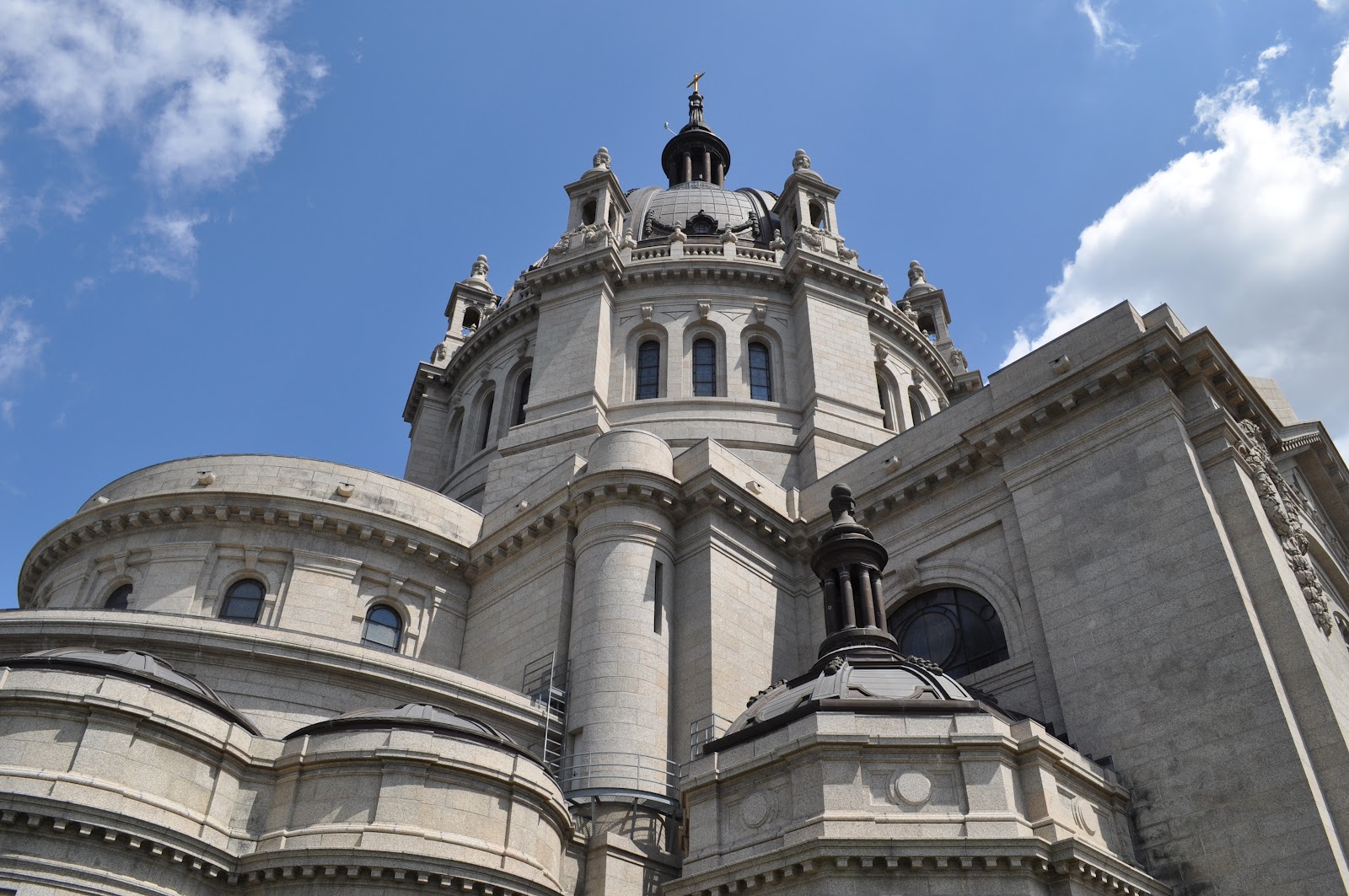
St. Paul's Cathedral
      Downtown St. Paul is one of the area's hidden gems: it gets no where near the attention of it's larger sibling. The Landmark Center is a large, gothic building in the middle of downtown St. Paul. It contrasts starkly with the glass and iron of a modern city-center. It was built to showcase the Federal Government's presence in Minnesota, shortly after the territory attained statehood. It also acted as an FBI outpost during prohibition and the mobster era, as the Twin Cities were used as a refuge fromChicago's tightening police force. Today, the Landmark Center is full of art museums, and used as an exhibition hall. A few blocks away, the Minnesota Science Museum watches over the Mississippi. The stone Cathedral looks down from it's hill, a stoic guard to rest of the city.
The Alleys of St. Paul


      St. Paul's Cathedral, the entity from which the city derives it's name, is an impressive edifice. It towers from it's hill over downtown, it's spires reaching to Heaven. Inside, frescoes and shrines decorate the halls, and sea-blue stained glass covers the domed ceiling. The beauty of the Cathedral is something unexpected. The shadows of saints and of the Crucifix filled the silent building. Tours must be taken with a guide, who is a volunteer member of the congregation. Our guide was very clear that building was built as an act of Worship, that the art was to express the artists' love for God.
      St. Paul and Minneapolis are nice cities. They show true potential to develop into a major city-center, and serve as a hub for economics, art, and culture in an area which is very lacking of all three. Their push towards modernization shows that they desire this outcome- there are even plans to build a high-speed train connecting St. Paul with my hometown, Duluth; this would be only the 2nd high-speed train in the United States. Minnesota has long held the mold of rotten small towns, funny accents, dive bars, and lack of any knowledge of culture that isn't Nordic. The signs of change however, are beginning to appear. It looks like if the United States is going to finally make the changes necessary to become a modern nation, it's going to start in the middle.


Wednesday, August 22, 2012

China Pt. 3: Canton Lost


"Fading Act" A man demonstrates the lost art of Cantonese Finger Painting
     Our guide greeted us at the airport by saying, “I'm glad you made it, but please hurry. There is a typhoon coming.” At that moment, I knew I was in love. As we drove through the city of Guangzhou, which was formerly known as Canton, I remarked to my mom that it looked like San Francisco and Las Vegas, combined, and quadrupled in size. Egg-Carton mountains guard the back of the city, and the Pearl River runs directly through the Central Business District. Many districts are made up of small island chains that lie in the river. It was the first Chinese city I'd seen that actually incorporated color into it's design. The buildings weren't red and gray. To the untrained eye, Guangzhou looked like a Feng-Shui masterpiece.
A Bridge over the Pearl River
      The Pearl River Delta is on China's southern coast, near the border with Hong Kong and Macau. It is right along the Tropic of Cancer; every day temperatures reached about 90 F. and it would thunderstorm for about 1 hour every afternoon, around 3:00. My camera lens literally fogged up when I stepped outside. Despite the humidity, the air was far cleaner and generally more breathable than anywhere else in China. We actually saw the sky when it wasn't raining. Guangzhou itself is around 13 Million, but is considered part of the Pearl River Delta Mega-City; comprised of Hong Kong, Macau, Shenzhen, Guangzhou, and several other smaller cities. Altogether, the population is estimated to be upwards of 40 Million, causing it to be considered by many as the most densely populated region on Earth. The region, due to it's proximity to Hong Kong and it's strategic positioning at the far south-eastern coast of China, was among the first to receive economic reform, and holds many important financial institutions. Because it's economy is so much farther developed, they have been able to place attention on making life quality better for their citizens. Mopeds are illegal, and cars aren't allowed to drive on the sidewalk. The infrastructure of the city is much more evolved than that of Beijing or Henan Province. Health Care is apparently more easily accessible, and to ride the Metro is free for residents.
      We were staying at the Guangdong(The name of the Province) Victory hotel, which was located on Shamian Island. Shamian is an island on the Pearl River, separated from the “mainland” by a distance of about 10 feet. During the European Occupation, Shamian was where the French and English set up their concessions. Now the old consular buildings are galleries, businesses, and hotels. The southern part of the island is a large public park, where folk musicians play and people gaze at the glittering cityscape. The Island is a popular place with professional photographers doing photo-shoots. On any given day, you could see hundreds of couples getting their wedding pictures done. Sometimes the photographers would be arguing over who got that street section. From what we gathered, the different agencies provide newlyweds with rental dresses, hair and makeup, and a photo-shoot on Shamian Island.
      Our guide, “John,” was Cantonese, along with the majority of Guangzhou's(Canton's) population. Cantonese people, although they belong to the Han ethnic group, are very distinct culturally. They speak their own language and posses a more “Bohemian” feel than most of China's population. But most noticeable is their diet. To use John's own words: “We eat everything.” Once, I asked him if they used alternative energy in Guangzhou yet, because the air was so much cleaner than the rest of China. I tried to explain alternative energy by telling him of how back home in California they were attempting to use kelp as an energy source because it grows nearly a meter every day. He replied that in Guangzhou, they wouldn't try to turn it into electricity. “If we had something that grew that fast, the first question would be, 'can we eat it?'”
      I'm addicted to tea. Some would say it's merely an unhealthy obsession. Living so close to San Francisco's Chinatown has forced me to grow up with some of the most delectable teas in the world only an hour BART ride away. If you're ever in the SF Area, I recommend the Red Blossom Tea Company in Chinatown. It's honestly the best shop in all of San Francisco. Anyways, when I was researching things to see in Canton, I discovered that it is the port where nearly All the Tea in China(Yes, I was silently chuckling as I wrote that) is exported from. There is an entire district of the city, Fangcun, which is a dedicated tea market: the largest in the world with over 5,000 vendors. Mainstream teas, such as Jasmines and Oolongs rest in large barrels on the street, while the rare finds such as Pu-Erh and roasted Tung Ting sit on shelves suspended from the ceiling. I even encountered several teas I had no idea existed: I picked up a bundle of Guangdong Bamboo Tea, an herbal tea used exclusively for medicinal purposes that is made of, you guessed it, bamboo leaves. Tangerine Tea is black tea, aged inside a hollowed out tangerine; the darker the tangerine skin, the older and higher quality the tea inside. Both the Tangerine and Bamboo tea were bitter, and unlike anything I'd ever tasted before, but utterly delicious once you got accustomed to them. Even in such a global society as the one in which we currently live, there are some things that don't make the trip across the pond. I purchased several kilos of tea, a tea table for performing Gongfu Cha, and an Yixing teapot. Yixing is a special type of clay only found in a certain region of China; this clay has chemical makeup which allows it to absorb the flavor of the tea being brewed in it, and after several years of continuous use and care, the addition of tea leaves is unnecessary. If an Yixing pot is left for a long period of time without use, however, the clay begins to crack. There are Yixing pots that are centuries old, passed down from generation to generation.
The Six Banyan Pagoda
      Visiting the Temple of Six Banyan Trees was a surreal experience. We did not realize that it was still an active temple, and were rather surprised to find some 50 monks, chanting around three golden Buddha statues, each around 30-40 feet high, when we arrived. The central pagoda was built around 1200 years ago, and the religion practiced was a variant of Chinese Buddhism, with many elements of Dao mixed in. I became excited when John informed us that there was a vegetarian restaurant on the the temple grounds, however, it was open only to the lamas. The ancient beauty of the pagoda, temple, and surrounding gardens contrasted starkly with the modern hubbub of bustling Guangzhou; not that it isn't a beautiful city, it's just beautiful in a completely different way. The English language really is inadequate.
The Chen Hall
      The Chen Ancestral Home, also known as the Guangdong Folk Art Museum, doesn't boast as lengthy history as most of China's historical sites at a mere 120 Years Old. It's doors and very floors are covered in ornateness. Different forms of artwork native to the Guangzhou area are on display. Some rooms are set up as they would have been in a wealthy Cantonese home during the early 20th Century. The ancestral altar is still provided with bowls of burning incense even though the building is now a government run art museum.
"Old Canton" Stalls at the Qing-Ping Market
      Across the canal from Shamian Island lies one of China's most notorious places: The Qing-Ping Market. Despite government efforts to clean up the market's act, it still remains as a haven of grit and grime in a very “glitter-minded” city. I loved it. It's primary function is that of a medicine market, although there are several vendors selling tea, family altars, and pet supplies. The market is in Guangzhou's oldest district, the last collection of precolonial buildings in the city. The aged apartments are several stories high, and the bottom floors are reserved for market stalls. Blankets covered in drying seahorses, legs of some unidentifiable animal, and mushrooms the size of small children are common sites at Qing-Ping. All was fine, until we came to the “live produce section.” I really don't want to recall too many details, but there were many animals, being sold in a less than humane way, that in the Western world it is considered wrong to eat, IE, kittens.
"Changing China" The Canton Tower at night
The CBD New Town
      The Canton Tower is currently the world's second tallest tower, and it looks huge from it's base. We went up into the top, and the view is dizzying and impressive. However, when viewing it from the Pearl River, it actually doesn't appear much larger than the surrounding buildings. Apparently, around 6 years ago the city decided that they wanted to redesign their downtown area. They tore the entire Central Business District up, renamed it New Town, and built it up anew as a modern testimony to the power of a centralized government mixed with an international financial center, and completed it with a synchronized light show. The result is truly astounding. The seventh tallest building in the world, the IFC Building, is directly across the river from the Canton Tower, and the city's less recognizable buildings bask in their neon. We took a night cruise down the Pearl River, on a “Dragon Boat” decorated in it's own floating light parade. There was a musician playing a zither on the top deck of the boat, and the weather was perfect. The city's color changing LEDs danced, as if in sync with the music. An ancient pagoda stood next to the Canton Tower, overshadowed by it's sheer mass. In the cab on the way back to our hotel, John told us when he would bring us to the airport in the morning. It was our last night in China.
      At the airport we said a teary goodbye to John. It's funny how attached you can grow to someone after spending 7 days with them. As we stood in line at customs, we took one last glimpse of the “Making the noises is forbidden” signs that were plastered all over the public transit hubs. We saw one final Red Guard, standing sentry on the Chinese side of the Immigration line. Our flight to Tokyo was delayed because of another typhoon. We'd only been there for 17 days, but it already felt strange being out of China, on the No-Man's-Land of an international airport. We boarded the plane, and I took one last glance out of the picture window facing the mountains. Goodbye, China.