After my sojourn in China, I had a
brief 10 day period of rest at home in California. When planning out
my summer, I had thought that 10 days would be more than enough time
to catch up with friends, sleep, and decent vegetarian food before
flying out again- I was wrong. Still slightly battered and weary, I
showed up at the San Francisco Airport. To say the least, I could
have been more gracious to the security staff. It was a red-eye
flight, after all.
As the plane approached Minneapolis, I
opened up my window. A black anvil of a cloud loomed over the city,
and the sunrise shown behind it. The edges of the cloud were tinged
with every hue of the rainbow, and I realized that the cloud itself
was lighting up. Every 20 seconds or so, the cloud would illuminate
itself, and the thunder roared outside the plane. I was seated next
to a teenage tourist from Wisconsin, who was no where near as
enthusiastic as I about the happenings outside our window. The plane
broke into the cloud, and the lightning shown all through the panes.
The lakes of the city echoed the colors of the sky, and the
Mississippi ran, hurtling into to the storm.
I was visiting family in Minnesota.
I've spent about half of my life up in Duluth, a city about 3 hours
north of the Minneapolis/St. Paul area, on the North Shore of Lake
Superior. The cultural differences experienced between California and
Minnesota may be more subtle than that of international travel, but
believe me, they're there. For someone who grew up in Minnesota,
particularly a rural northern city, it's interesting to observe the
funny little things people do differently. Especially the accents, as
well as the general manner of speech. Although I love to
poke fun at my relatives' funny accents, my friends from California
still laugh at my own- especially when saying certain words, such as
“bag” and “couch” or pretty much anything with a long vowel
sound in the center.
 |
| "Minneapolis Moon" The city as seen from Target Field |
Minneapolis and St. Paul are both very
clean, modern cities. They are collectively known as the Twin Cities,
or for anyone living within a 200 mile radius, as simply “The
Cities.” A few years ago, the Minneapolis Metro Lightrail was put
into place, although public transportation is still very limited. The
Lightrail currently only serves a small strip of Downtown
Minneapolis, but is being extended to portions of St. Paul as well.
Downtown infrastructure of both the cities is new, however, small.
Collectively, the Twin Cities Metro region is less than 4 million.
After seeing some of the Chinese cities, San Francisco felt small,
let alone Minneapolis and St. Paul.
 |
| The Minneapolis Metro |
The most famous attraction for the
area is the Mall of America, which is truly impressive. A vaster
temple of consumerism could hardly be imagined. The prices are
surprisingly competitive, and it is pretty fantastic to have an
aquarium, mall, and full sized theme park in one building. When it
comes right down to it, though, it's a mall. A really big mall.
Downtown Minneapolis is known for it's
nightlife, and consists of bars and clubs, as well as upscale
designer shops. The SkyWay system provides several blocks worth of
comfortable walking, even in the chill of winter. The aged Metrodome,
and mondern Target Field and Target Center remind you that
Minnesotans are serious about their sports. All of downtown
Minneapolis is plastered with banners for the respective Football,
Baseball, Hockey, and Basketball teams. With such a dedicated fan
base, it really is a shame they don't have a single winning team.
 |
| The Landmark Center |
 |
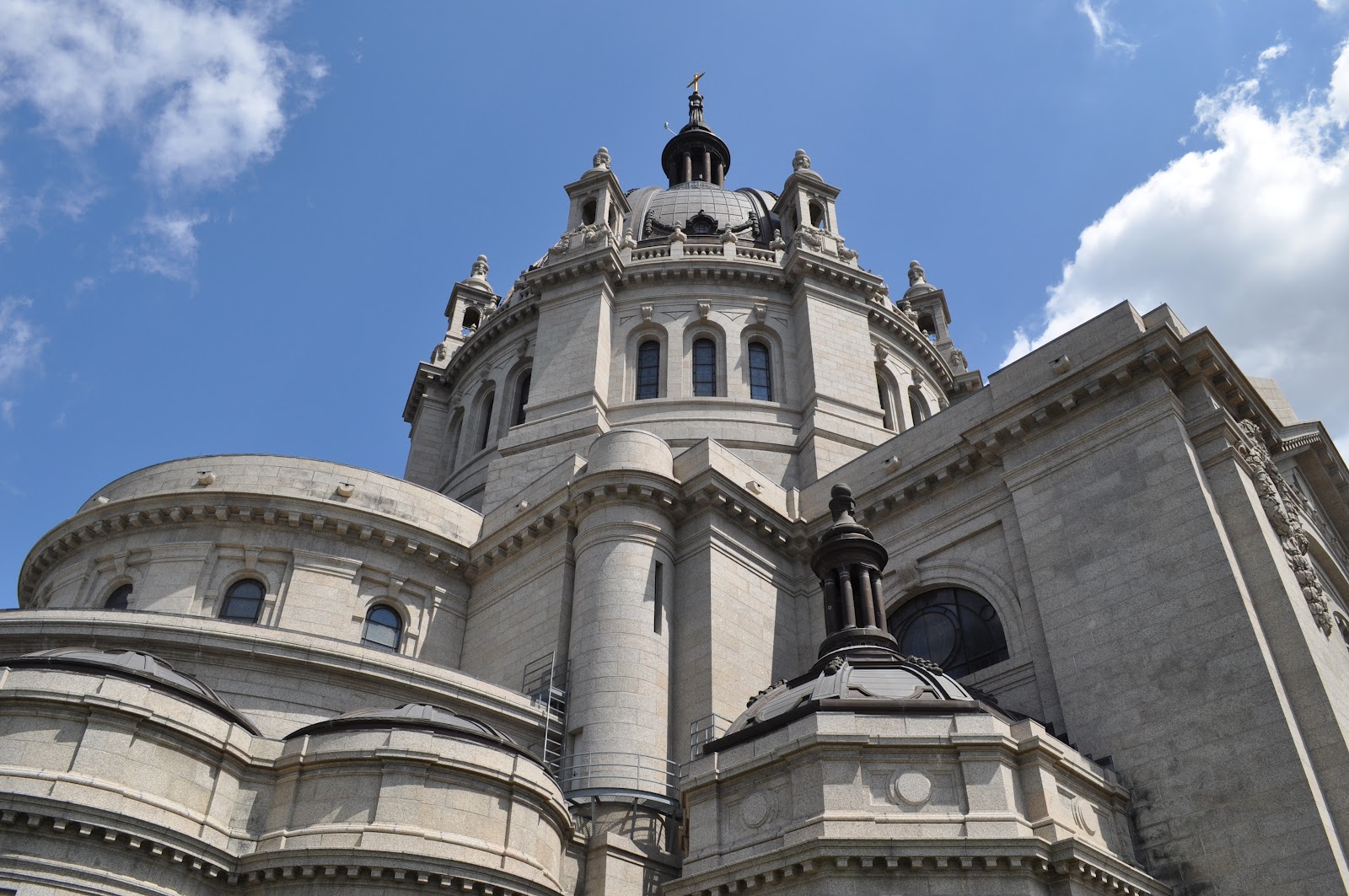
| St. Paul's Cathedral |
Downtown St. Paul is one of the area's
hidden gems: it gets no where near the attention of it's larger
sibling. The Landmark Center is a large, gothic building in the
middle of downtown St. Paul. It contrasts starkly with the glass and
iron of a modern city-center. It was built to showcase the Federal
Government's presence in Minnesota, shortly after the territory
attained statehood. It also acted as an FBI outpost during
prohibition and the mobster era, as the Twin Cities were used as a
refuge fromChicago's tightening police force. Today, the Landmark
Center is full of art museums, and used as an exhibition hall. A few
blocks away, the Minnesota Science Museum watches over the
Mississippi. The stone Cathedral looks down from it's hill, a stoic
guard to rest of the city.
 |
| The Alleys of St. Paul |

 St. Paul's Cathedral, the entity from
which the city derives it's name, is an impressive edifice. It towers
from it's hill over downtown, it's spires reaching to Heaven. Inside,
frescoes and shrines decorate the halls, and sea-blue stained glass
covers the domed ceiling. The beauty of the Cathedral is something
unexpected. The shadows of saints and of the Crucifix filled the
silent building. Tours must be taken with a guide, who is a volunteer
member of the congregation. Our guide was very clear that building
was built as an act of Worship, that the art was to express the
artists' love for God.
St. Paul's Cathedral, the entity from
which the city derives it's name, is an impressive edifice. It towers
from it's hill over downtown, it's spires reaching to Heaven. Inside,
frescoes and shrines decorate the halls, and sea-blue stained glass
covers the domed ceiling. The beauty of the Cathedral is something
unexpected. The shadows of saints and of the Crucifix filled the
silent building. Tours must be taken with a guide, who is a volunteer
member of the congregation. Our guide was very clear that building
was built as an act of Worship, that the art was to express the
artists' love for God.
St. Paul and Minneapolis are nice
cities. They show true potential to develop into a major city-center,
and serve as a hub for economics, art, and culture in an area which
is very lacking of all three. Their push towards modernization shows
that they desire this outcome- there are even plans to build a
high-speed train connecting St. Paul with my hometown, Duluth; this
would be only the 2nd high-speed train in the United
States. Minnesota has long held the mold of rotten small towns, funny
accents, dive bars, and lack of any knowledge of culture that isn't
Nordic. The signs of change however, are beginning to appear. It
looks like if the United States is going to finally make the changes
necessary to become a modern nation, it's going to start in the
middle.