Showing posts with label Urban. Show all posts

Thursday, January 3, 2013

A Lack of Color

Over winter break, I had the opportunity to go out and shoot some of my favorite local spots. I ended up shooting quite a bit of Black and White, and thought that it'd be appropriate to open the New Year with some of my favorite shots from the end of 2012 and the beginning of 2013.

"Hidden Chinatown" A women working in Chinatown's Golden Gate Fortune Cookie Factory

Oakland's Cathedral of Christ the Light
The interior of the Cathedral of Christ the Light

The Bay Bridge at night

St. Peter's and St. Paul's in North Beach

"Down Paradise Alley" A natural double exposure

Fire Escapes

Sunday, September 9, 2012

Minneapolis/St. Paul

-->
      After my sojourn in China, I had a brief 10 day period of rest at home in California. When planning out my summer, I had thought that 10 days would be more than enough time to catch up with friends, sleep, and decent vegetarian food before flying out again- I was wrong. Still slightly battered and weary, I showed up at the San Francisco Airport. To say the least, I could have been more gracious to the security staff. It was a red-eye flight, after all.
      As the plane approached Minneapolis, I opened up my window. A black anvil of a cloud loomed over the city, and the sunrise shown behind it. The edges of the cloud were tinged with every hue of the rainbow, and I realized that the cloud itself was lighting up. Every 20 seconds or so, the cloud would illuminate itself, and the thunder roared outside the plane. I was seated next to a teenage tourist from Wisconsin, who was no where near as enthusiastic as I about the happenings outside our window. The plane broke into the cloud, and the lightning shown all through the panes. The lakes of the city echoed the colors of the sky, and the Mississippi ran, hurtling into to the storm.
      I was visiting family in Minnesota. I've spent about half of my life up in Duluth, a city about 3 hours north of the Minneapolis/St. Paul area, on the North Shore of Lake Superior. The cultural differences experienced between California and Minnesota may be more subtle than that of international travel, but believe me, they're there. For someone who grew up in Minnesota, particularly a rural northern city, it's interesting to observe the funny little things people do differently. Especially the accents, as well as the general manner of speech. Although I love to poke fun at my relatives' funny accents, my friends from California still laugh at my own- especially when saying certain words, such as “bag” and “couch” or pretty much anything with a long vowel sound in the center.
"Minneapolis Moon" The city as seen from Target Field
      Minneapolis and St. Paul are both very clean, modern cities. They are collectively known as the Twin Cities, or for anyone living within a 200 mile radius, as simply “The Cities.” A few years ago, the Minneapolis Metro Lightrail was put into place, although public transportation is still very limited. The Lightrail currently only serves a small strip of Downtown Minneapolis, but is being extended to portions of St. Paul as well. Downtown infrastructure of both the cities is new, however, small. Collectively, the Twin Cities Metro region is less than 4 million. After seeing some of the Chinese cities, San Francisco felt small, let alone Minneapolis and St. Paul.
The Minneapolis Metro
The most famous attraction for the area is the Mall of America, which is truly impressive. A vaster temple of consumerism could hardly be imagined. The prices are surprisingly competitive, and it is pretty fantastic to have an aquarium, mall, and full sized theme park in one building. When it comes right down to it, though, it's a mall. A really big mall.
      Downtown Minneapolis is known for it's nightlife, and consists of bars and clubs, as well as upscale designer shops. The SkyWay system provides several blocks worth of comfortable walking, even in the chill of winter. The aged Metrodome, and mondern Target Field and Target Center remind you that Minnesotans are serious about their sports. All of downtown Minneapolis is plastered with banners for the respective Football, Baseball, Hockey, and Basketball teams. With such a dedicated fan base, it really is a shame they don't have a single winning team.

The Landmark Center
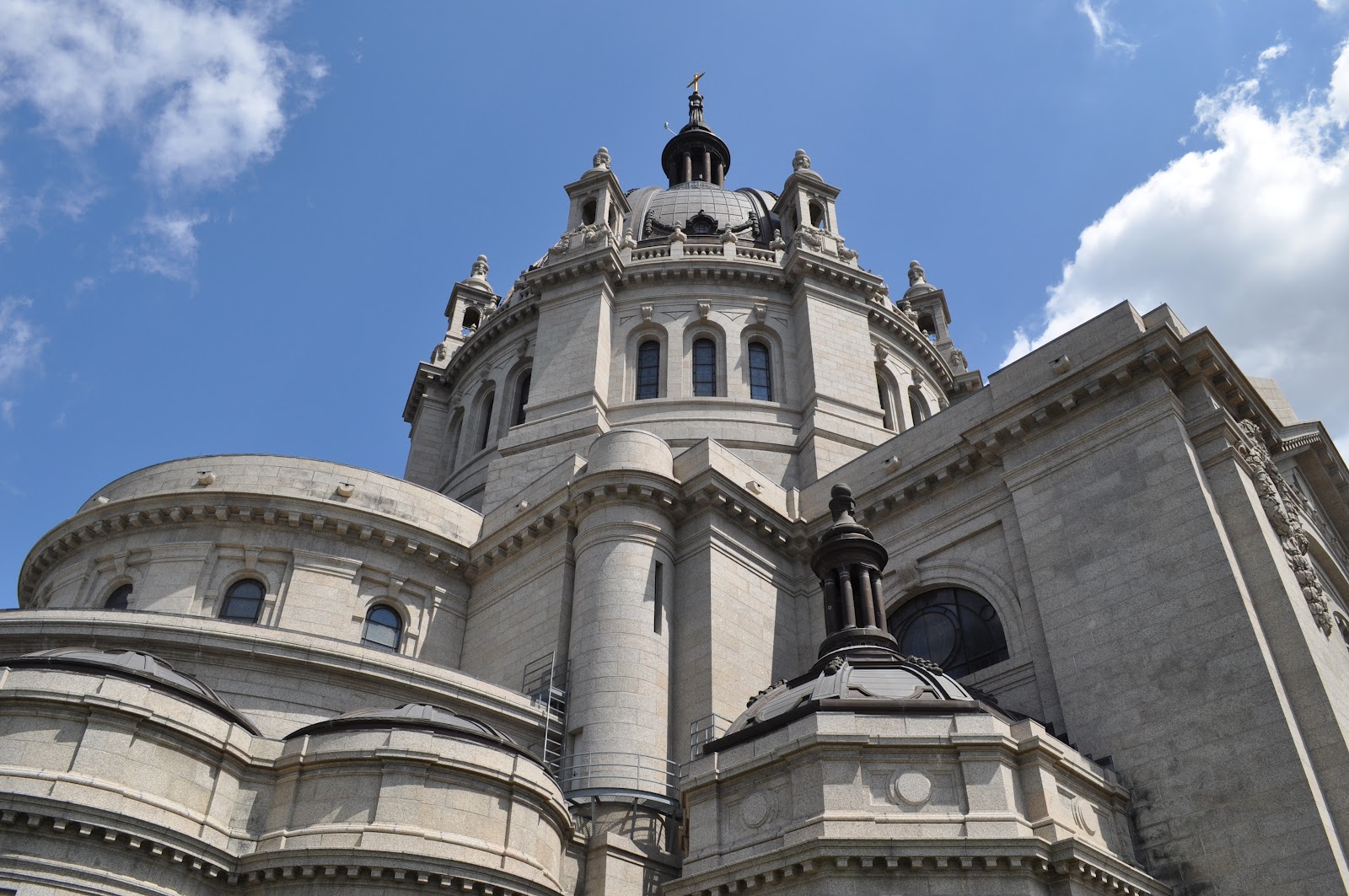
St. Paul's Cathedral
      Downtown St. Paul is one of the area's hidden gems: it gets no where near the attention of it's larger sibling. The Landmark Center is a large, gothic building in the middle of downtown St. Paul. It contrasts starkly with the glass and iron of a modern city-center. It was built to showcase the Federal Government's presence in Minnesota, shortly after the territory attained statehood. It also acted as an FBI outpost during prohibition and the mobster era, as the Twin Cities were used as a refuge fromChicago's tightening police force. Today, the Landmark Center is full of art museums, and used as an exhibition hall. A few blocks away, the Minnesota Science Museum watches over the Mississippi. The stone Cathedral looks down from it's hill, a stoic guard to rest of the city.
The Alleys of St. Paul


      St. Paul's Cathedral, the entity from which the city derives it's name, is an impressive edifice. It towers from it's hill over downtown, it's spires reaching to Heaven. Inside, frescoes and shrines decorate the halls, and sea-blue stained glass covers the domed ceiling. The beauty of the Cathedral is something unexpected. The shadows of saints and of the Crucifix filled the silent building. Tours must be taken with a guide, who is a volunteer member of the congregation. Our guide was very clear that building was built as an act of Worship, that the art was to express the artists' love for God.
      St. Paul and Minneapolis are nice cities. They show true potential to develop into a major city-center, and serve as a hub for economics, art, and culture in an area which is very lacking of all three. Their push towards modernization shows that they desire this outcome- there are even plans to build a high-speed train connecting St. Paul with my hometown, Duluth; this would be only the 2nd high-speed train in the United States. Minnesota has long held the mold of rotten small towns, funny accents, dive bars, and lack of any knowledge of culture that isn't Nordic. The signs of change however, are beginning to appear. It looks like if the United States is going to finally make the changes necessary to become a modern nation, it's going to start in the middle.


Saturday, August 11, 2012

China Pt. 1: The Spirit of Peking


       The plane en route from San Francisco to Beijing was crowded. After 13 wrenching hours of flight, a fellow passenger stood up, looked in my direction, and shouted, “Welcome to China!” A flight attendant announced over the loudspeaker that visibility in Beijing was “Under one mile today,” with a hint of irony in her voice. People poured out of the airliner as it was being gutted to travel across the Pacific once more.
      Our van from the airport careened down a crazy, spinning Hutong alleyway. It was at this moment that I determined that China must be called the Land of the Dragon because of it's twisting roadways. Road Laws seem to be more Road Guidelines in China. The “right of way” is decided by whoever has the guts to pull into the intersection. Electric mopeds catapult across sidewalks, down streets, and through walkways in herds, like startled antelope with no where to run. Pedestrian traffic is left to take it's life into it's own hands. If you can run fast enough, you can cross the street.
      Wangfujing is Beijing's central shopping street. Grime covered buildings tower over streets caked with dusty pollution. A soft haze lends an ethereal element to the scene. While commercial centers, filled with designer Western clothiers dominate, traditional family businesses still carry on as they have for countless years. Wangfujing Cathedral stands as a black sheep; something which neither belonged in Ancient China nor it's confused identity crisis in which the nation currently rests. An unfinished shopping mall advertises Dairy Queen ice cream and Forever 21 Clothing. The notorious Beijing Night Market lies only a few blocks away.
      The Temple of Heaven, one of the landmark sights of China, shows a genius for acoustics. The little details make this site truly amazing- it's design is more simplistic than that of the Summer Palace or the Forbidden City; it's wonders are subtle. On top of the “Circular Mound Alter” (Really? Of all the names?) there is stone which lies in it's center. When standing atop this stone, you can hear your voice come from all directions. In the Hall of Echoes lie three pavement bricks, when standing on the first brick you hear your voice once, on the second brick twice, etc. The gold gilding remains as a shimmering reminder of China's wealth and power.
      Tienanmen Square. One of Communism's last outposts in the 21st Century world. Famous for it's 1989 Massacre and it's gargantuan portrait of the country's late leader, Chairman Mao Zedong, Tienanmen Square is a testimony to a national pride unheard of in the Western World. The deceased body of Mao is on display in a glass casket, and the Monument to the People's Heroes is still the dead center of Beijing. What many Westerners mistake for a tribute to the Red State is really a place as conflicted as the rest of the nation which it represents. The Tienanmen Square Protests of '89 were actually preformed by orthodox communists, who set themselves against the economic reforms of Deng Xiaoping and his successors. The Square is eerie in it's very presence. Red Guards and police vans still patrol the Square regularly, as if to make sure that everyone remembered where exactly they are. As an American who is not altogether the most patriotic person, Tienanmen Square served as a truly fantastic reminder that although our nation is far from perfect, we really do have something to be grateful for.
      Rising into the smog like a majestic bird, the Hall of Supreme Harmony is one of the most awe-inspiring sights that Man has ever created. The Forbidden City, with it's elaborate gardens, soaring rooms, and incredibly attention to detail cannot be described with the inadequate English language. “Beauty” simply does not cover half of the awe of the Imperial Palace.
A monk outside the Summer Palace
      The only thing I found truly striking in the Summer Palace was a large photograph, probably from the mid-sixties, printed onto a display board. The English caption simply read, “Pu-Yi and Mao Zedong.” The photograph featured two men shaking hands. If I hadn't read up on the history of China's last emperor, the picture wouldn't have appeared any different than any other photo of Mao. There are lots of those. Pu-Yi was China's last emperor. His story is one of the most understated tragedies of modern times, and I'd highly encourage you to read a more detailed account. Something about ending up as the gardener in the palace you grew up in puts a perspective on how much control we have truly have over our own lives.
      Snaking along the hills outside of Beijing's suburban areas is China's most iconic sight: The Great Wall. It truly is amazing, and I wish I could've spent more time climbing it. “He who has not mounted the Great Wall is not a true man.” -Mao Zedong
The Hutong. The one with the yellow front was our hostel.
      Beijing's magic lies in it's subtleties. Sure, there are the awe-inspiring sights of Ancient China and modern innovation, but the true spirit of Peking is embodied somewhere deep in an unpaved Hutong alleyway, where roast sticks of tofu can be found for 1 Yuan, and people are sitting outside, enjoying the evening over a cup of tea and a game of mahjong. One of my favorite experiences in China occurred in the Hutong Hostel we were staying in. To my knowledge we were the only guests staying in the courtyard home, which had been converted into a hotel/hostel. The staff was comprised of students who all lived together in the home and managed the guest rooms. One evening, my mother and I were invited to join them for a Dragon Boat Festival Party, as it was Dragon Boat weekend, one of China's larger holidays. We were told to return in an hour, so we went for a walk around the hutong where the hotel was located and the surrounding alleys. Upon returning, we found that the lobby had been decorated and that they had baked us special lotus-wrapped dumplings that are only served during Dragon Boat. They wanted us to play a game with them, and it turned out that the game they had in mind was something similar to charades. We played charades for nearly 2 hours. Our Chinese is terrible, and their English was comparable, but we still had the time of our lives. I have the feeling that those 2 hours that I spent in a hostel in a little alleyway somewhere in the urban sprawl of Beijing playing charades will stick with me for quite a while. 
My mother and I with the staff of our hotel

Wednesday, July 18, 2012

China's Change

                                                                     "Transitions"

     It looked like something out of a Cultural Revolution propaganda piece. Five farmers walked with rakes and shovels in hand along the rural road about 50 kilometers outside of Beijing. Each wore an olive-drab hat, adorned with a single red star. Wheat was spread out in patches along the road, drying beneath a sun hidden by layers of pollution.
      Deep within the urban sprawl of Beijing, The Monument to the People's Heroes lies in the center of Tienanmen Square, flanked by Red Guards. Across the square, Chairman Mao smiles benevolently down at his people from the northern gate of the Forbidden City. Merchants hawk their wears, which include copies of Mao's “Little Red Book” and t-shirts sporting an image of “Obamao,” which features the President's face pasted into the Chairman's famous military uniform.
      China is a land of contradictions. In some aspects it appears to be a frighteningly regimental society, plagued by an overzealous government, while any amount of time on the chaotic streets of Beijing would make you think otherwise. 1,000 year-old temples lie in the shadow of modern skyscrapers. Communist Party buildings stand within blocks of international bank chains. Wangfujing Avenue's many malls and highrise hotels show the world's largest country's push towards Western modernization, while aspects of the ancient hutong (narrow alleys of courtyard homes, restaurants, and shops) culture remain intact.
      In the Temple of Heaven park, an elderly man and woman stood, worshipping the Tree of the 9 Dragons, a 500 year old Chinese Juniper. Meanwhile, thousands lined up in Tienanmen Square, waiting for a chance to glance at Chairman Mao, whose body is on display in a glass casket. A few kilometers from the square, in an unfinished shopping mall, Western chain stores and restaurants attracted an untold number of China's youth. International tourists are still a novelty, as Americans are often asked to have their picture taken.
      There is a “Lost Generation” in China, although it is nothing as romantic as the Parisian expats of Hemingway. Many of the elderly Chinese still cling to the fading religious customs of their ancestors, whether Taoist, Buddhist, or some combination of the two. It is difficult even for the strongest government to expel nearly 2,000 years of tradition. Tienanmen Square, with it's devotion to the deceased Chairman and his Party, is filled with many people of all ages, however, those of middle age predominate. Growing up in a “Continual Revolution” shows it's products in China's middle aged citizens. There is, however, one age group that does not yet seem anchored. The young people of China live in a continually changing nation, in it's own adolescent stages. Western chain stores and banks have taken root in urban metropolises. McDonald's stores look out on ancient streets near the centuries old Forbidden City, which is bordered with Tienanmen Square. The contrast provides young Chinese with an apparently uncomfortable choice: forsake the rigid, militaristic comforts sought by their parents, as well as the ancient ways of thought and life belonging to their grandparents, for Western ideas and culture, or keep up with the traditions of either one. Both Maoism and ancient thought require China to withdraw within itself, while succumbing to American and European ideology will ultimately destroy both of China's unique thought systems.
       The young people of China face a serious choice, as their decision will change global politics and economics- for better or for worse.


                                                                    "Temple Park" -A man paints characters with water outside the Temple of Heaven in Beijing.

                                                       A very modern bridge in Guangzhou
 
                                                                   "Canton Lost"- Guangzhou's skyline.


Wednesday, December 21, 2011

San Francisco- Pt 2

 "Alone in A Crowded Place" A man waits for his train at the Powell St. BART Station.
 "Chinatown, USA"
 "The Old And The New" Coit Tower, framed by a construction crane.
 "TA Building" The TransAmerica Pyramid.
"Expressions" A graffiti mural in the Mission District.

San Francisco: A land of contrasts. From the pagodas of Chinatown to the skyscrapers of the Financial District, from the slums of the Tenderloin to the mansions of Pacific Heights, SF is a city unlike any other.

San Francisco- Pt 1

 Chinatown. This was shot with a Holga Lens, which I feel encompasses the "feel" of Chinatown: Gritty, funky, and utterly wonderful.
 "Grant Ave"

 
"The Window To the Sea" Shot at the ruins of the Sutro Baths.
 Coit Tower and the TransAmerica Pyramid, as seen from Pier 39.
A Sea Cave near the ruins of the Sutro Baths.

Living near the City By the Bay has given me many opportunities to explore it's nooks and crannies, and to enjoy it's unmatched beauty and appreciation for art. These photos are from no particular dates, they are just a few of my favorite pictures of my favorite city.